Accessibility, or putting people at the center
The experience of the Uffizi Galleries
by Francesca Sborgi
Accessibility is understood today as a global approach that impacts the entire life of a museum: from governance to collection care, from cultural mediation to communication, from reception to building meaningful relationships with communities. The museum is no longer a place that ‘preserves’ or ‘displays’, but a social infrastructure capable of generating well-being, participation, recognition, and opportunities. Every person who enters – regardless of their abilities, experiences, culture, or vulnerability – brings with them a unique way of perceiving, reading, and experiencing spaces. Accessibility, therefore, does not concern some visitors: it concerns everyone.
In this context, the experience of the Uffizi Galleries represents a privileged laboratory. Not only because it is one of the most visited museum complexes worldwide, but because in recent years it has chosen to radically rethink the relationship with its audiences, placing cultural mediation, the plurality of experiences, and people's well-being at its center. In 2016 the Cultural Mediation and Accessibility Department was established, dedicated to educational activities, inclusive projects, initiatives with marginalized communities, cultural welfare paths, and the design and creation of mediation tools.
To understand the scope of the activities developed in recent years, it is appropriate to pause on the very nature of the museum complex itself. The Galleries are in fact a cultural ecosystem composed of four distinct but closely linked realities: the Uffizi with the Gallery itself and the exhibition rooms housed in the Vasari complex, also including the Historical Archive, the Library, the Loggia dei Lanzi; Palazzo Pitti which houses five different museums; the Vasari Corridor the famous elevated passage connecting the two banks of the Arno, reopened to the public in 2024; the Boboli Garden a historic 32-hectare park full of architecture, fountains, grottos, sculptures, and botanical species. Together, these institutions form one of the most extraordinary concentrations of artistic heritage in the world, displaying masterpieces by Botticelli, Leonardo, Raphael, Michelangelo, Caravaggio, and many other eras and schools.
The Uffizi Galleries are among the most visited museums in Europe, with millions of annual entries. This means managing, daily, in spaces with strong historical connotation and not expandable, intense and constant flows, high sensory loads, and issues related to overcrowding, as well as diversified needs of a composite and international audience.
Therefore, the challenges concern not the quantity but the quality of the relationship with visitors. This involves a profound redesign of fruition: not only accompanying people inside the museum but making possible an experience as autonomous, personal, rewarding, and sustainable as possible.
The peculiarity of the Department also lies in its position ‘between’ museum education and communication: a meeting point between cultural design, relationship with audiences, and inclusive processes. The value of direct experience with the public is important: the department team indeed comes from museum reception work – a often underestimated but decisive field. Being daily in the rooms, observing how people relate to space, detecting implicit needs and critical issues, allows developing a concrete, not abstract sensitivity and enables reading people's real needs and thinking of activities and tools that work.
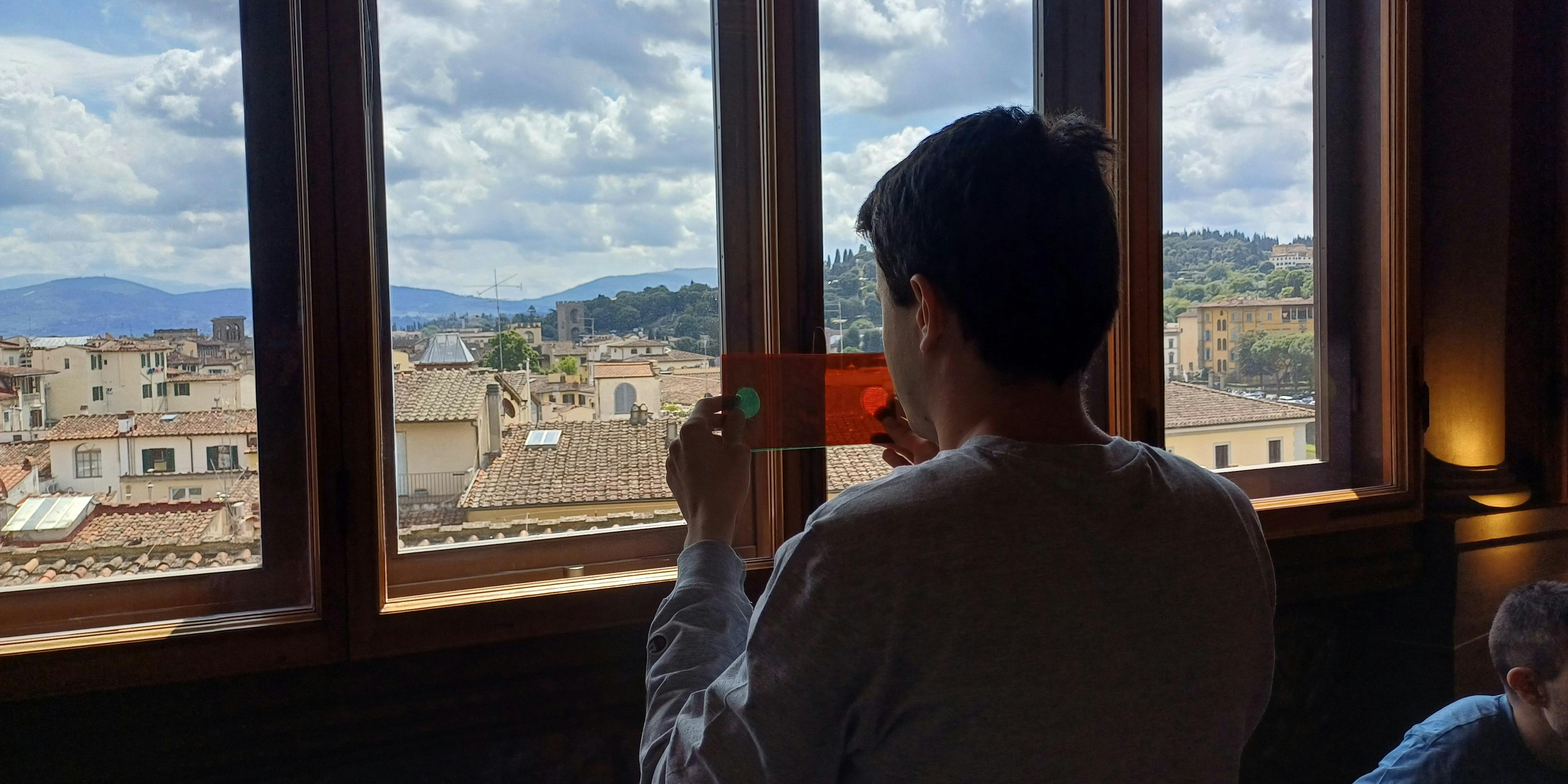
Various accessibility tools respond to the assumption ‘Uffizi for everyone’. The Activity Bag is a simple but effective device for cognitive accessibility. It allows an autonomous and calm visit thanks to the social story (which presents the visit route with images and simple texts), educational cards, and objects that help manage sensory stress. It is designed especially for people with autism spectrum disorders but can be used by everyone: elderly, children, visitors facing crowded situations with difficulty.
For deaf people, LIS video descriptions and visual vernacular focused on the masterpieces of the Uffizi are available. Recently, a new LIS video format has been made available to enhance the museums of Palazzo Pitti and Boboli.
On the Uffizi institutional portal are available the ‘Hypervisions’: digital narratives that select works from the collections and build thematic paths capable of speaking to different audiences. They are not traditional educational tools, but stories that activate emotional and cultural relationships. Among these, there is the path Views from the World an intercultural project that involved migrants, offering the possibility to select a work they feel connected to, telling it in both Italian and mother tongue. The result is a mosaic of points of view that enriches the museum and makes it a place of recognition. A similar path to this, but enriched with podcasts narrated by the participants, is Story Factories where audio, a restitution of a cultural mediation path and a shared and participatory reflection, gives voice to personal stories and allows overcoming language and visual barriers.
Tactile experience at the Uffizi also has a long history, which we intend to continue because together with people's needs, museums and exhibitions also change. Currently, the paths include exploration of sculptures, tactile panels and maps, a series of tactile books usable at home, with audio QR, multisensory experiences.
In these, added value is given by blind mediators: the relationship reverses, the seeing visitor – who is invited to wear a blindfold – is guided by those who live daily in darkness. A dynamic of mutual trust is triggered that goes beyond teaching, becoming a true human experience. This is the case of the project Boboli, Garden of the Senses which exploits the park's immersive dimension in a visit path through sensors and smart canes, where listening to natural sounds, tactile exploration of plants, perception of smells and textures combine in a narrative weaving botany, history, and bodily perception.
Our experience shows that a museum can be, simultaneously, a place that houses masterpieces, produces beauty and knowledge, but also an environment that generates well-being, a context where people find recognition, a community that welcomes and does not judge, a laboratory of cultural citizenship. Accessibility, for us, is the thread that holds these dimensions together. It is a dialogue path with communities and their aesthetics that is certainly not finished, but always ongoing: it is a journey, a continuous path, where we strive to put every person we meet at the center.
This content is released under the terms and conditions of the so-called “Free Culture” Creative Commons license – CC BY-SA (https://creativecommons.org/licenses/by-sa/4.0/); this license allows, citing the source, to use and share contents by any means and format, as well as transform them, for any purpose including commercial, and with the ability to sublicense contents to other publishers in the future, provided with the conditions and terms of the same CC BY-SA license.
Various ownership and license terms are explicitly indicated.