Cultural participation? It is (still) a privilege
Examples of intercultural and community practices that reduce barriers
by Francesco Mannino
Addressing today the issue of social and cultural barriers means taking on a delicate theme of contemporary democratic life: the unequal opportunity to take part in culture, not only as consumption, but as an experience of citizenship and as a multiple enabler. If cultural participation is a form of relation with the community and the shared heritage, its denial or limitation produces exclusion, isolation, and loss of social ties. Access to culture, in other words, is not a luxury or an accessory of public life: it is a fundamental right that allows one to consciously inhabit society. However, in Italy, this right is still conditioned by a system of layered barriers – physical, sensory, cognitive, and then economic, territorial, and digital, but above all social and cultural – that reflect and reproduce the broader inequalities of the country. It is no coincidence that only one in three people residing in Italy can count on a full cultural life, dropping to one in four in Sicily and Calabria, and one in five among minors in those regions (ISTAT BES 2024).
Social barriers often manifest invisibly, intertwining with the history and structure of cultural institutions themselves. It is not only about obstacles related to income, so-called abilities, geographic distance, or lack of free time: what is decisive is the perception of culture as a space ‘not for everyone’. Museums, theaters, libraries, and archives are places founded with a public vocation but have often maintained in practice a language, an aesthetic, and a socially selective, excluding, and in some cases classist rituality. The very way a cultural experience is communicated or staged can exclude those who do not master its codes. It is not only physical, cognitive, or sensory barriers but a set of subtle signals – the language used, the tone, implicit norms, behavioral rules – that make a large part of the population feel entirely out of place. This feeling of inadequacy is among the most powerful forms of social exclusion from a cultural perimeter that is easily defined as ‘high’.
Cultural barriers, on the other hand, concern the symbolic and narrative framework through which society defines what culture is and to whom it belongs. The Italian cultural imagination, despite its richness, remains strongly Eurocentric, male, white, heterosexual, able-bodied, adult, and middle or upper-middle class. This means that the experiences, aesthetics, and memories of those coming from other cultural horizons – migrants, Afro-descendant, Asian or Latin American people, Roma, new citizens or so-called second generations, generally underrepresented groups – are often marginalized, if not invisibilized. In museums and cultural institutions, the Italian colonial history is still little told and rarely critically addressed; the presence of other narratives is episodic, left to the goodwill of individual curatorial or educational professionals, not supported by systemic orientation.
In the publication Un patrimonio di storie. La narrazione nei musei, una risorsa per la cittadinanza culturale, edited by Simona Bodo, Silvia Mascheroni, and Maria Grazia Panigada in 2016, some pioneering intercultural response initiatives carried out in some Italian museums in the pre-COVID decade are reported, such as Brera: un'altra storia at the Pinacoteca di Brera, TAM TAM – Tutti al Museo at the Museum Popoli e Culture in Milan, or Al museo con... Patrimonio narrati per musei accoglienti at the then Pigorini Museum in Rome. Different is the experience of the Hall of Life of the Egyptian Museum, which deals not only with the study of human remains but also with the theme of their exhibition and the ethical implications that characterize it: this initiative aimed to make the offering of the Turin museum truly accessible to cultures very different from the Eurocentric one.
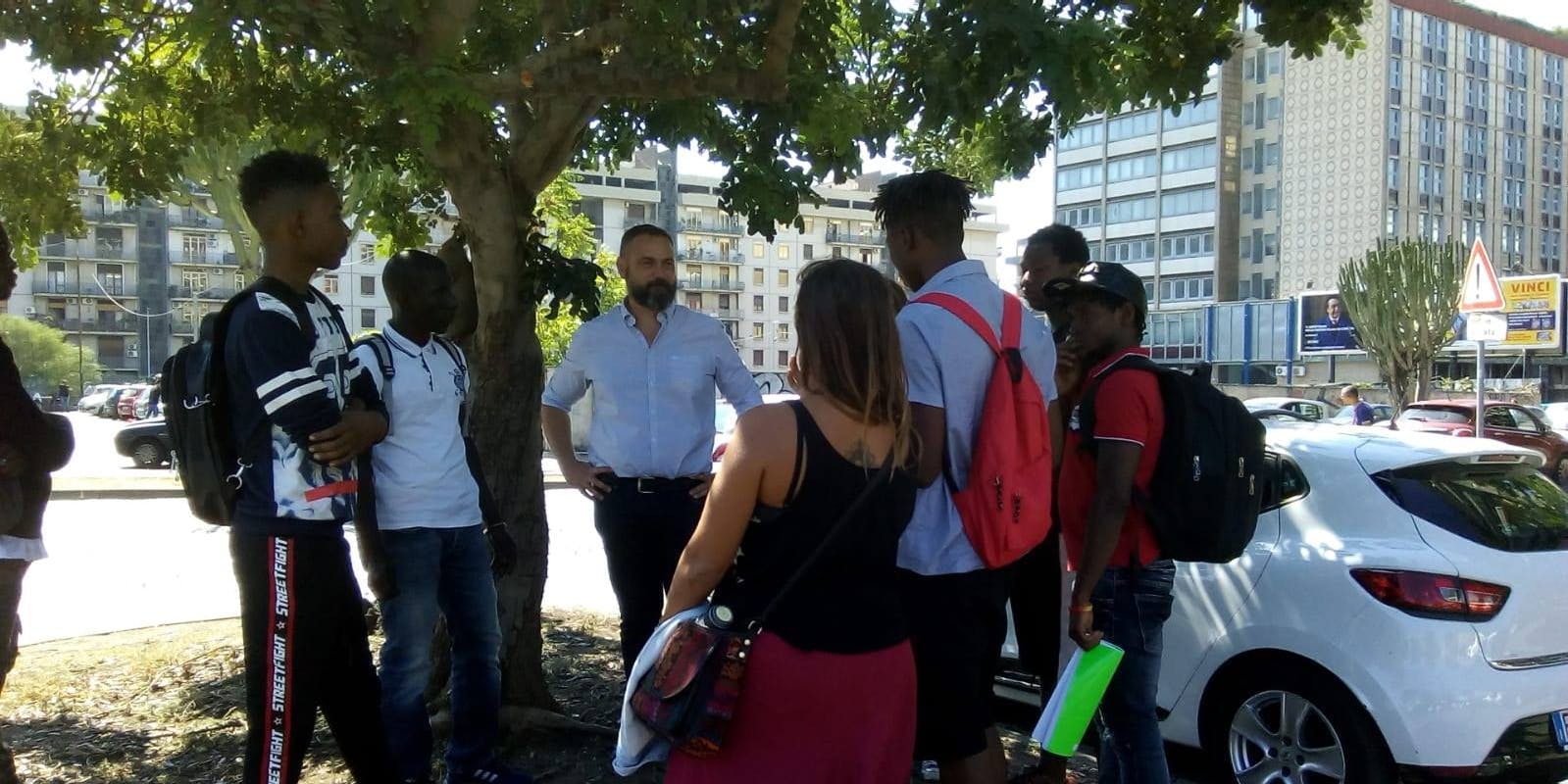
In Catania, Officine Culturali experienced a work grant scheme with a young man from Guinea Conakry, who arrived on the Sicilian island after one of the many landings crossing the Sicily channel. The involvement aimed to guide the young Alpha Oumar to work autonomy, through progressive support from the cultural operators of Officine Culturali, in activities aimed at knowledge of the heritage and increasing cultural participation. The work grant also served to strengthen his linguistic skills in Italian. His role in welcoming at the Monastery of the Benedictines had both a practical and symbolic value: it allowed him to engage with a wide public and showed visitors how a young person welcomed in our country could in turn be a ‘guest who welcomes’. Alongside him, a dialogue was initiated on cultural barriers that hinder access to heritage by people with different backgrounds. From this work arose the approach of ‘functional comparison’, which relates functions and meanings of very different places and architectures to experiences and contexts familiar to the visitor, facilitating understanding. This methodology enriched the educational practices of Officine Culturali, which then applied it in other contexts with young people from diverse origins, often involving Alpha Oumar himself.
These are just some examples of practices aimed at ensuring that public culture does not continue to reflect only a seemingly monolithic and homogenizing national identity, which excludes those who do not identify with it. In general, the Italian cultural narrative rarely reckons with linguistic and symbolic barriers, stereotypes and gender dominions, different generational needs, with what can be called ‘other’ culture and which instead – indeed – is widely spread and participated in.
The exclusion of people with migratory backgrounds is an emblematic example of how social and cultural barriers overlap. Migrant people and their offspring, often born and raised in Italy, face multiple obstacles: linguistic, economic, administrative, but also symbolic. It is not only about ‘not being able to enter’ places of culture, but about not feeling invited, represented, or recognized as part of the collective narrative. As with many classist discriminations, distance here is not only physical or economic but also elitist: many cultural places implicitly communicate a selective sense of belonging, where those who do not fit the norms of the ‘typical’ audience are perceived as temporary guests, not as full cultural subjects: that 'high' culture mentioned before barricades itself within golden fences, invisible yet equally insurmountable.
The cultural institution, in this context, risks becoming a space of asymmetric power: those who hold the language, the curatorship, the resources, produce representations that others can only observe. It is concrete power, exercised in the selection of stories to tell, in the images chosen for communication, in the collections exhibited, in the construction of discourses and paths, in the choice of voices left on the margins. Cultural accessibility, therefore, cannot be reduced to breaking down architectural barriers or using inclusive digital or communicative tools: it requires deep self-reflection work by the institutions themselves, a revision of their paradigms of meaning, their practices, their relationships with communities, their strategic priorities, and above all the deep meaning of their visions.
There are experiences that show a different way. In several Italian cities, projects of participatory cultural mediation, librarianship, and social museology are experimenting with forms of opening that consist not only in 'bringing the public to the museum', but in bringing the museum (the library, the musical or theatrical performance) into communities, even deconstructing the ‘deficit model’ (expert-who-makes-culture vs layperson-who-enjoys-it) to build cultural products and practices with those communities.
Examples include experiments like the program La cultura dietro l'angolo in Turin, through which Compagnia di San Paolo, Ufficio Pio, the Municipality of Turin and a consolidated network of third sector entities — with Neighborhood Houses in the lead — have been addressing, since 2021, the phenomenon of relational poverty, especially in the suburbs, thanks to a delocalization of the cultural offer by entities such as the Museo Egizio, the Teatro Stabile, the Teatro per Ragazzi e Giovani, the Unione Musicale, and many others, even giving rise to practices and products designed precisely to strengthen interpersonal relationships. Also, through the project Traiettorie Urbane, the Edison Orizzonte Sociale Foundation and the social enterprise Con i bambini have supported a coalition of third sector entities committed to tackling child poverty in eight neighborhoods of Palermo through participatory performative practices, collective transformation of public space in a cultural and artistic key, social sport. In Catania the Librineria, an experiment of a self-managed library in the working-class neighborhood of Librino, has become an essential cultural gathering hub in the very place of the activities of the Briganti, now a well-known social rugby team that faces territory conflicts and inequalities responding with awareness and unity. In Scampia, the MOSS – Ecomuseo Diffuso Scampia, Naples’ first ecomuseum, was born in 2021 from a project Chi rom... e chi no, developed together with a group of professionals from the territory. In May 2023 the ecomuseum opened its ‘invisible doors’ for the first time, offering itineraries and public art installations spread across the neighborhood's spaces and on the terraces of the Italo-Romani gastronomic space Chikù. The collective works are created by people living in Scampia — especially children, youth, and families — who become active actors and custodians of local stories.
Many other projects can be mentioned: welcoming libraries in Turin and Bologna, or experiments in museums in Milan (Brera), Bergamo (GAMEC), Naples (MANN), and live performances in Catania (the dance of Public Scenario, the juggling of Ursino Buskers, the music of Sambazita. Associazione Musicale Etnea, Darshan and MusicaInsieme Librino, but also social theater workshops of Officina SocialMeccanica and Officine Culturali), which offer every day different ways to interpret cultural practices and the places connected to them, allowing people who are not used to or not in a position to do so, to participate widely and actively.
When culture is collectively elaborated, and not only offered, it ceases to be a device of distinction to become a tool of relation. Co-curation initiatives, shared archives, intercultural workshops, neighborhood narratives, or community artistic practices demonstrate that participation is possible only when institutions accept to decentralize and make room for other perspectives. Accessibility is then measured not by the number of visitors, but by the quality of the relationships activated.
But to make these changes structural, it is necessary to overcome the logic of the event or episodic project and build long-term cultural policies that recognize cultural diversity as a resource and not as an exception. This means, for example, supporting the training of cultural professionals with migratory backgrounds, including linguistic plurality in mediation devices, and rethinking governance models in a participatory key, from budgets to decision-making bodies. It means supporting fewer projects (destined to expire in their inevitable cycles) and more subjects (collectives, such as ETS, social enterprises, and cooperatives) capable of generating, with patience and vision, concrete long-term social impacts. Inclusion requires processes of co-decision, co-responsibility, and redistribution of cultural power: in such cases it can even become coexistence, one of the highest – and most horizontal – forms of human democracy.
The biggest challenge, however, is cultural in the deepest sense: it is the need to redefine who has the right to say ‘we’ when talking about culture in Italy. In a country that tends to conceive its cultural identity as an immobile heritage, opening it up to the contribution of those who arrived later – or those historically excluded – does not mean losing it, but making it evolve. Italy is not only its past but also the sum of its presents: languages, music, faces, and stories that live in it today.
Recognizing social and cultural barriers therefore means not only denouncing a lack, but imagining a future in which culture is truly a common good, accessible, shared, and plural. A perimeter that reasons for coexistence among people, not for asymmetrical top-down inclusion. It is not about ‘bringing culture to everyone’, but giving everyone consciously willing the opportunity to participate in building culture. Only in this way can cultural participation become what it should be: a living form of democracy, and its founding prerequisite.