
The museum as a possible space: practices and research perspectives
Neurodiversity and accessibility practices to rethink the museum experience
For most of my life I was told that I should struggle more than other people: at school, in social contexts, in finding my place. Many of the energies I put into adapting were not recognized. They were simply needed to get closer to a standard designed for neurotypical people.
In this way the difference always remained present, but was rarely named.
However, growing up I discovered that there was a space where my way of being in the world found a different kind of breathing: art. Museums and exhibitions have been necessary places for me, places of decompression. At the same time I realized that some museums were more welcoming than others, while in some cases the experience was difficult, if not even hostile.
It is from this experience that my research on museum accessibility began.
When I moved to Rome, I began to encounter words like ableism and internalized ableism. Understanding these concepts meant recognizing that many difficulties were not related to people, but to contexts designed for a single type of functioning.
In the last twenty years, the paradigm of neurodiversity has begun to question exactly this assumption. Introduced at the end of the 1990s within online autistic communities, and later systematized in sociology, the term proposes to read the variety of neurological functions as part of human diversity, similarly to biodiversity. In this perspective the issue is not to ‘correct’ differences, but to question the environments that produce exclusion.
If this debate is now central in many educational and social areas, in the museum field its application remains uneven. Many museums continue to think of accessibility as a technical intervention: a ramp, a simplified caption, a dedicated video. Important tools, but which often do not question the way the institution imagines its audience.
It is precisely in this gap between theory and practice that my research fits.
This doctoral project originates from the attempt to understand how museums can become truly livable places also for neurodivergent people, not through occasional adaptations but through a rethinking of educational and relational practices.
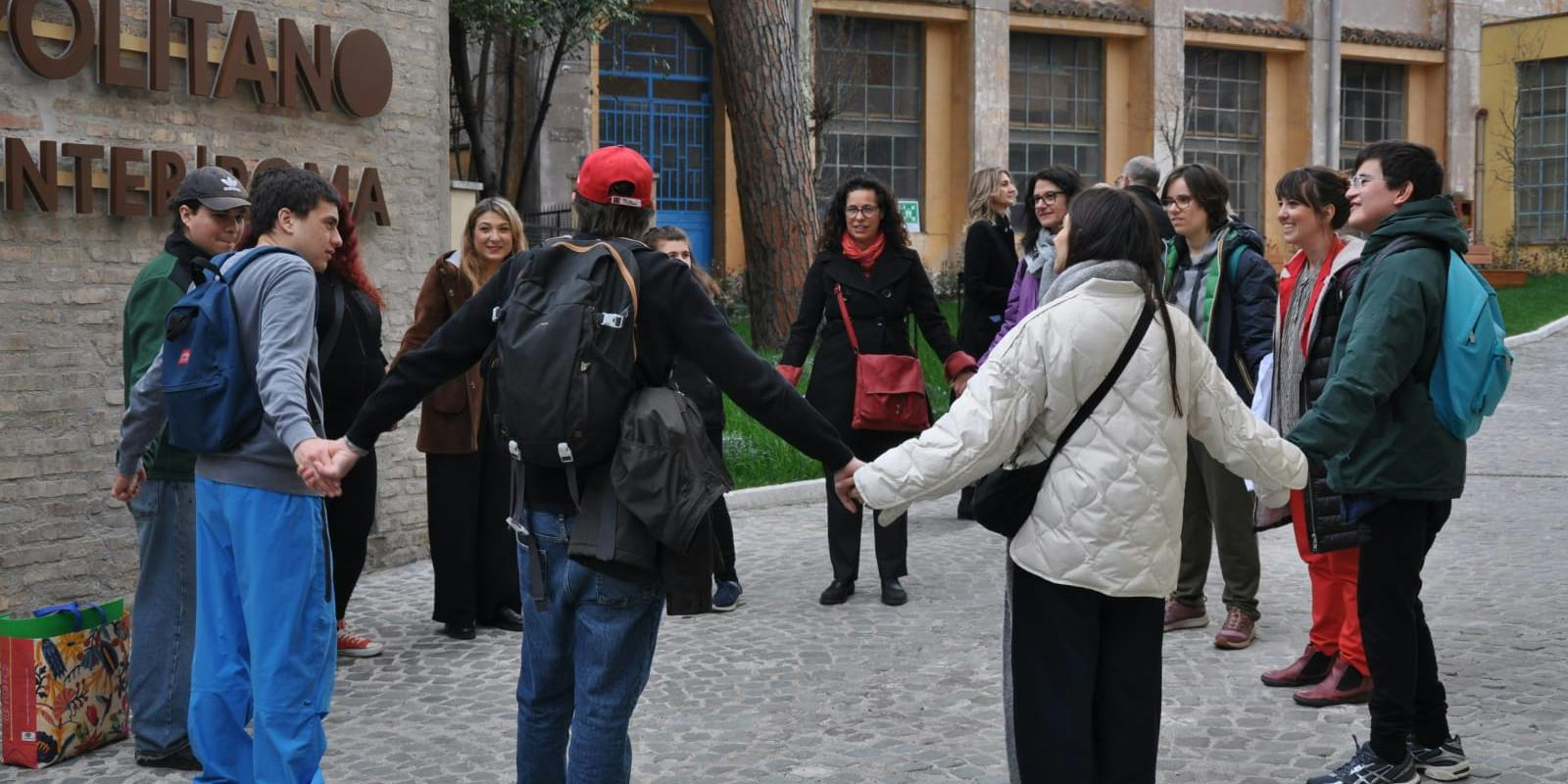
A central part of this research was developed in the field together with the association Fateci Posto APS, born in Rome as a relational space for neurodivergent adolescents and young adults with high care needs. Meeting the Association allowed us to transform theoretical research into a concrete experience.
In these years we have carried out 60 accessible museum visits in various Roman museums, progressively building a working methodology, which takes shape from a simple premise: a museum visit is not a lesson, but a relational experience.
For this reason, the design does not only concern the contents, but also the sensory context, the timing of the visit, the building of trust within the group. Some tools proved particularly useful: preparing the experience through personalized social stories that anticipate the stages of the visit; the possibility to pause before works without strict times; repeating visits in the same museum to build familiarity with the space.
Another essential element was to bring activities inside the museum rooms, avoiding the separation between 'general' audience and 'special' audience. This small shift often generated significant effects: the museum stops being a space to observe at a distance and becomes a place to inhabit.
Over time I realized that the central issue was not only methodological, but also political.
The disability studies emphasize how accessibility means questioning who has the power to define what a ‘normal’ cultural experience is, which behaviors are considered appropriate and which instead deviate from the neurotypical model. In the case of neurodivergences, these boundaries become particularly visible: tight visiting times, overstimulating environments and one-way communication are elements that can make the museum a difficult space to navigate.
For this reason, during the research, a principle became central in our work: lowering the level of expectations to increase the level of trust. Lowering expectations means suspending the idea of a 'correct' visit to be followed step by step. Increasing trust means recognizing that each person can find different ways to relate to the works, to the space and to others.
When this happens, it happens that the museum stops being just a place for knowledge transmission and becomes a space of cultural self-determination. People spontaneously stop in front of a work, return several times to the same museum, build relationships with the space. Not because they have to, but because they choose to. In this sense neurodivergent knowledge is not simply an object of study, but a perspective that can transform the very way we think about cultural institutions.
It's not just about asking how to make a museum accessible but rather how can a museum allow itself to be transformed by the people who pass through it.
To learn more
Freire, P. (2002). The Pedagogy of the Oppressed (C. Alziati & L. Bimbi, Trans.). EGA. (Original work published 1968).
hooks, b. (2022). Teaching Community: A Pedagogy of Hope (feminoska, Trans.). Meltemi. (Original work published 2003).
Taylor, S. (2021). Beasts of Burden: Disability and Animal Liberation (feminoska, Trans.). Edizioni degli animali. (Original work published 2017).
Walker, N. (2021). Neuroqueer Heresies: Notes on the neurodiversity paradigm, autistic empowerment, and postnormal possibilities. Autonomous Press.