Accessibility, participation and well-being of trans and non-binary people in museums
Towards trans-inclusive museums: ethics, practices, and cultural responsibility between accessibility and rights
by Cesare Cuzzola, Dani Martini, Nicole Moolhuijsen
If the field of accessibility has gained more and more space in the debate and practices related to cultural heritage in Italy [1], becoming in the last decade one of the central themes also from the point of view of structural investments and generating evident impacts on the quantity and quality of training projects, an aspect long neglected concerns the reception, participation, and well-being of trans and non-binary people in cultural places. This perspective should gain increasing importance and awareness among those working with culture for multiple reasons. On the one hand, because it concerns a minority marked by persistent dynamics of social exclusion in various areas of society, from healthcare to education and culture, due to structural barriers, prejudices, and stigmatizations, often reinforced by a politics that questions their right to self-determination, including through the use of violent and polarizing language in public debate [2]. On the other hand, as highlighted by numerous research and publications in various fields of study, gender, from a conceptual point of view, is a mutable sociocultural construct that has assumed multiple facets throughout history [3]. Its representation within cultural institutions, for example through processes of reinterpreting collections, can contribute to breaking down stereotypes and prejudices, promoting an understanding that goes beyond dominant polarizations and allows grasping its broad, non-binary, and constantly evolving nature [4].
In a context marked by growing political hostility, both internationally and nationally, towards LGBTQIA+ issues and particularly affecting the trans community, there have been, especially in the United States, actual acts of cultural censorship of this community’s history, such as the removal of the letter 'T' from the Stonewall National Monument website, a symbolic site of the birth of the LGBTQ+ movement [5]. In this scenario, the ICOM Italy LGBTQ+ Gender and Rights working group [6] has decided to dedicate particular attention to these issues, aiming to offer those working in the cultural sector an ethical and methodological framework of reference to face them with awareness, on multiple operational levels.
The document Museums and Genders: Ethics, Methods, and Approaches to Promote a Trans-Positive and Accessible Culture in Cultural Institutions, published in 2025 and freely accessible online, arises from a collaboration between ICOM Italy and the Research Centre for Museums and Galleries of the University of Leicester. It is the translation and adaptation for the Italian context of Trans-Inclusive Culture. Guidance on advancing trans inclusion for museums, galleries, archives and heritage organisations, published in 2023 with the support of over twenty cultural sector partners, including several international ICOM commissions.
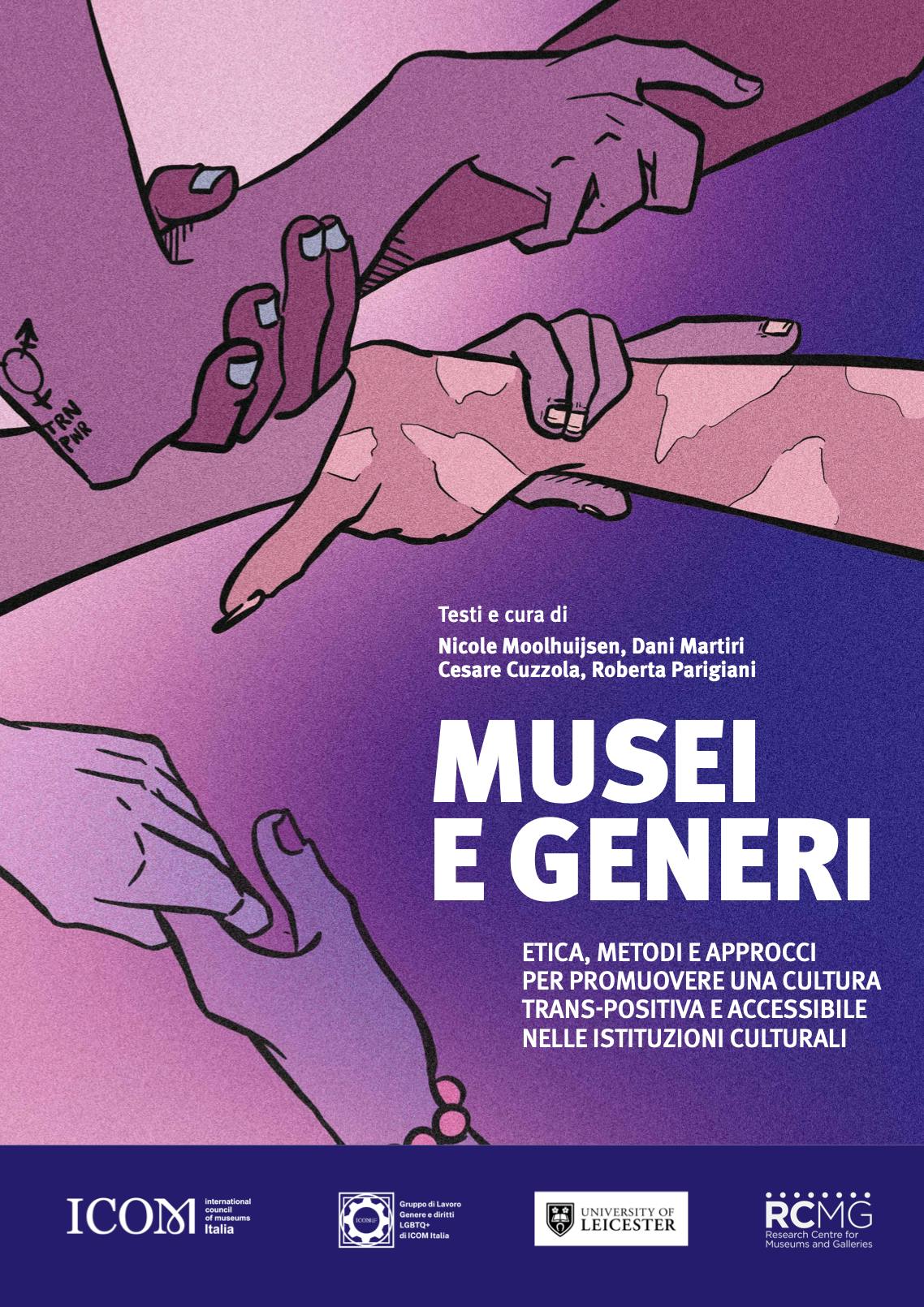
Cover of the volume Musei e Generi, Copyright ICOM Italy. Illustration by Nicky Daigoro. Graphic layout We Exhibit.
From a methodological point of view, the adaptation work has placed the embodied experience of trans and non-binary people living and working in the Italian context at the center. In addition to conducting a qualitative survey based on interviews with members of the trans community aimed at understanding the barriers that hinder access and participation in cultural institutions, the project team is largely composed of trans and non-binary people. At the same time, the sponsorship of the main trans activist associations active in Italy has been requested: MIT – Movimento Identità Trans, Genderlens, Libellula Italia APS, Associazione Transessuale Napoli, Sportello Trans Ala Milano Onlus. From this process emerged a critical analysis that led to the modification and implementation of several sections compared to the original document in English. In particular, greater attention was reserved for the language issue, with guidelines aimed at overcoming the use of the generic masculine and exploring inclusive practices even in non-administrative contexts; the focus on childhood and the relationship with schools was expanded, as well as legislative references related to Italian law, thanks to the fundamental collaboration of lawyer Roberta Parigiani, co-author of the document.
The core of the document consists of an ethical and methodological framework that spans all areas of museum operation, from cataloging and acquisition practices to educational activities and relationships with audiences, up to personnel policies and governance. Putting trans-accessibility into practice, in fact, does not mean merely rethinking the relationship with museum visitors, although this dimension is fundamental, but implies a critical analysis of all the assets that support and structure the institution's activity.
The reflection questions that the ethical and methodological framework aims to answer are:
- How can we design exhibitions, events, and programs that are accessible and inclusive for trans audiences?
- How can we ensure a respectful and safe environment for trans audiences?
- How can we build an accessible organizational culture for trans people?
- How can we actively collaborate with trans communities to promote real participation?
It is important to underline that, within an organization, these questions should be addressed in an integrated way within a broader design on Equity, Diversity, and Inclusion (DEI) issues, and not considered as sporadic or additional interventions. The document also insists on the central role of staff training, hoping for the involvement of people with embodied knowledge, local associations, and figures with specific expertise in these areas.
Finally, the document concludes with a set of ethical guidelines to address some of the most recurring dilemmas organizations encounter when working on these issues. These dilemmas concern, for example, interpretative questions (such as how to enhance the genderqueer aspects of a collection), personnel management aspects (how to build consensus within an organization), or language use, both institutional and online (how to counter hate speech on the web). Overall, eleven scenarios provide an ethical orientation aimed at addressing these issues with awareness of their complexity, with humanity, and with firmness in respect of the principles of non-discrimination also established by Italian law and in relation to the right to culture [7].
To date, Musei and Generi is beginning to be adopted as a reference by some Italian realities, helping to fill a structural gap in knowledge and training tools on these issues. Although the path towards a real assumption of responsibility by cultural institutions towards LGBTQIA+ claims is still long, concrete signs of change are emerging: a growing number of institutions active on these topics and the creation, within ICOM Italy, of a dedicated working group made up of professionals committed to these areas [8]. These transformations demonstrate that supporting LGBTQIA+ advocacy through culture is not only urgent but also possible: a cultural policy choice that recognizes culture as indissolubly linked to principles of rights and equality for all people [9].
[1] Maria Chiara Ciaccheri, Musei e accessibilità, Editrice Bibliografica, Milano 2024.
[2] Inclusion4All – Trans, Intersex and Nonbinary people at work, https://inclusion4all.eu; Kate Doyle Griffiths, “Queer Workerism Against Work”, in Transgender Marxism (a cura di Jules Joanne Gleeson, Elle O’Rourke), Pluto Press, London 2021, p. 135; Isa Borrelli, Gender is over, Feltrinelli, 2024.
[3] Alex Iantaffi, Meg-John Barker, La vita non è binaria, Odoya, Bologna 2024; Kit Heyam, Before We Were Trans, Basic Books, 2022; Lou Ms.Femme, Rivoluzione non binaria, le plurali, Roma 2025.
[4] Laurajane Smith, Emotional Heritage, Routledge, London 2020, p. 259.
[5] BBC, Transgender references removed from Stonewall Monument Website, https://www.bbc.com/news/articles/cglywwn29n6o
[6] Gruppo di Lavoro – Genere e Diritti LGBTQ+ https://www.icom-italia.org/gruppo-di-lavoro-genere-e-diritti-lgbtq/.
[7] Art. 21 of the Charter of Fundamental Rights of the European Union, taken up in the policies of the Direzione Generale Musei, http://musei.beniculturali.it/progetti/ad-arte.
[8] Nicole Moolhuijsen, Musei, genere e queerness, Nomos Edizioni, Busto Arsizio 2026.
[9] Richard Sandell, Museums, Moralities and Human Rights, Routledge, London 2016.